Erika Fischer-Lichte, August 11, 2010
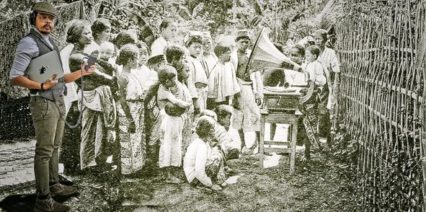
In this article Erika Fischer-Lichte argues that, since the beginning of the twentieth century, in different parts of the world, modern theatre was invented by way of interweaving cultures in performance. Different examples from the early twentieth century and the 1990s show how theatre acted as a laboratory for testing and experiencing the potential of cultural diversity. An innovative performance aesthetics enabled the exploration of the emergence, stabilization, and destabilization of cultural identity, merging aesthetics with politics. read more
Thomas Martius, May 2, 2013
Takao Kawaguchi: The Foyer read more
David Savran, March 28, 2013
© David Savran 2011 For the first time during my travels abroad, I decided to keep a journal, expecting that I would want to record and process the extraordinary experiences I knew I was going to have. Since I am a careful observer of foreign cultures and always try to get to know local artists, this journal, quite unintentionally, became schizophrenic: half a Western tourist’s Orientalist musings and half the attempts of a student of culture to understand Egypt’s political and cultural economies. Reading it again in light of the uprising in Tahrir Square, I realized that my schizophrenic prose had unwittingly captured a “state of emergency,” a moment of coming-into-being, which, Walter Benjamin notes, “is not the exception but the rule,” and of which we become sensible only by hearkening to the “tradition of the oppressed.” These entries thus document a state of emergency which, like all such states, becomes recognizable only in retrospect. To my own journal, I append the first two emails I received from Egyptian friends after the revolution began. read more
Khalid Amine, March 27, 2013
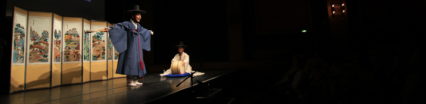
International theatre research has long studied the world before undergoing its revolution from the inside. Should the world study back or, rather, perform back while striving for recognition? The intercultural debate of the 1980s and 1990s implied the possibility of a democratic interweaving of performance cultures across the globe. Still, the task of postcolonial scholarship is further complicated by the existing body of world theatre histories. Our performance cultures are hardly visible in the “universal narrative of capital – History 1”, typically edited out, and otherwise often only mentioned on the borderlines between absence and presence. Europe has always been the silent referent in world theatre history. With rising demands for further democratizing the discipline, new modes of writing theatre history from below have emerged with an earnest desire for inclusion …. read more
Lydia Haustein, December 20, 2012
Did contemporary art revive historical thinking, which was once deeply rooted in China but almost extinguished by the Cultural Revolution? As art weaves a dynamic texture of traditional patterns, it does not, however, exhaust them in simply recollecting historical subjects. read more
Joy Kristin Kalu, October 29, 2012
In her article “On the Myth of Authentic Representation: Blackface as Reenactment“ Joy Kristin Kalu examines the current blackface debate from the standpoint of appropriation art and reenactment. She argues that the strategic repetition of historically loaded, in this case even racist practices can potentially lead to re-signification and thereby undermine conventions. Instead of demonizing blackface per se, she suggests conceiving performance as a political space of negotiation, thus allowing for the possibility, perhaps through citation, to generate new meanings for old aesthetic processes. read more
Thomas Martius, May 10, 2012
Workshop with Homi K. Bhabha © Thomas Martius read more
Thomas Martius, February 28, 2012
Workshop "On Dialogue". With Christel Weiler, Holger Hartung and Klaus-Peter Köpping. © Thomas Martius read more
Thomas Martius, October 13, 2011
Film presentation by Michael Roes © Thomas Martius read more
Erika Fischer-Lichte and Rustom Bharucha, August 6, 2011
To welcome the new Fellows to the International Research Centre “Interweaving Performance Cultures”, Erika Fischer-Lichte and Christel Weiler convened a meeting at the beginning of the academic year 2010/11 to discuss the Centre’s programme and concepts. The following conversation between Erika Fischer-Lichte and Rustom Bharucha about “interweaving” versus “intercultural” took place on this occasion. read more
Gastón A. Alzate, June 21, 2011
Soulemayne Mbodj In this interview with Gastón Alzate, Souleymane Mbodj discusses several issues relating to the interweaving of performing cultures. These include the unity of literature and the performing arts in Africa; his views on African and Western philosophy; his experience playing Bach’s second prelude in C minor with Lebanese and Armenian musicians; the appropriation processes and cultural fractures resulting from colonization; and the essential value of black music in the Americas for African communities to recover cultural ties shattered by the slave trade. He shares his thoughts on the crossroads and divergences between Africa and the West regarding ways of thinking and conceptions of art. read more